Basic aquaponics: complete guide from scratch
Aquaponics is a food production system that integrates aquaculture (fish farming) with hydroponics (soil-free cultivation), creating a closed ecosystem where fish waste is converted into nutrients for plants through natural biological processes. It is not a pretty project: it is a living system that depends on chemical, biological, and mechanical balance.
When properly designed, the system is highly efficient: it reuses water, reduces external fertilizers, and allows constant production in small spaces. When poorly designed, it fails quickly. There is no middle ground.
What is aquaponics?
Aquaponics combines two systems: aquaculture, which is fish farming, and hydroponics, which is growing plants without soil. The difference is that in traditional hydroponics you add fertilizers to the water. In aquaponics, nutrients mainly come from the fish and the bacterial activity of the system.
The goal is not simply to keep fish alive and plants looking nice. The goal is to create a circuit where water moves, becomes oxygenated, transports nutrients, feeds the roots, and returns to the tank in better condition.
Why use aquaponics?
Aquaponics is beneficial because it takes advantage of resources that are normally wasted. In a traditional system, fish waste becomes pollution if it is not filtered. In aquaponics, that waste becomes fertilizer.
- Saves a lot of water because the system recirculates.
- Reduces or eliminates the need for chemical fertilizers.
- Allows cultivation in small spaces.
- Produces vegetables and, if the system scales, also protein.
- Reduces soil problems, weeds, and some pests.
- Can work in a patio, balcony, carport, terrace, or small farm.
It is not regular gardening. It is food production using applied biology.
How the system works
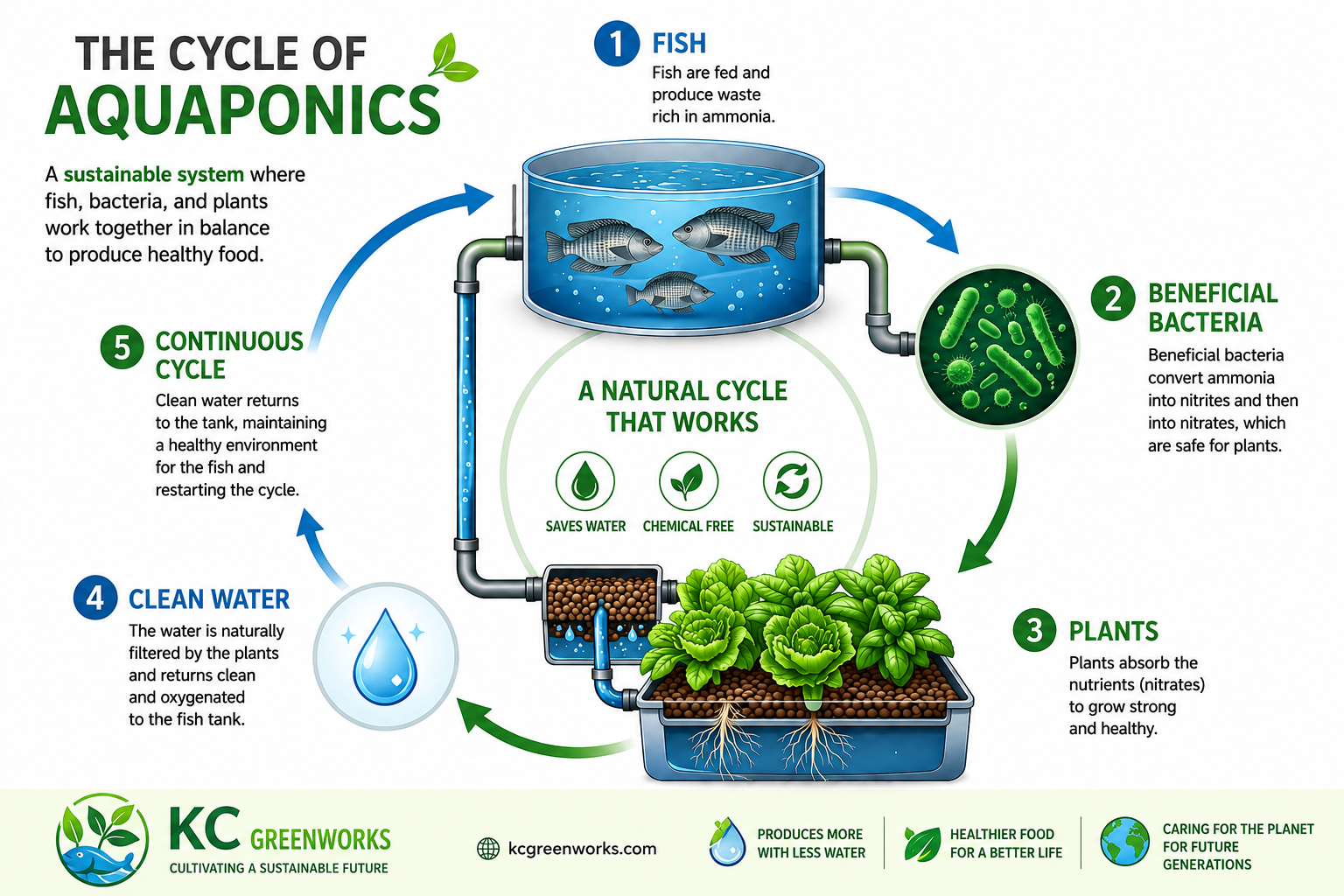
Everything revolves around the nitrogen cycle. Fish eat and produce waste. That waste releases ammonia, which can kill fish if it accumulates. This is where nitrifying bacteria come in.
- Fish produce ammonia.
- Bacteria convert ammonia into nitrites.
- Other bacteria convert nitrites into nitrates.
- Plants absorb nitrates as food.
- The water returns cleaner to the tank.
Bacteria do not only float in the water. They live attached to surfaces: stones, gravel, expanded clay, roots, filters, and pipes. That is why the physical design of the system matters so much.
Scales: from a fish tank to a large system
You can start small. A fish tank can serve as a laboratory to learn: small pump, some plants above, roots exposed to water, and good oxygenation. That system will not produce much food, but it teaches you flow, evaporation, water quality, roots, and fish behavior.
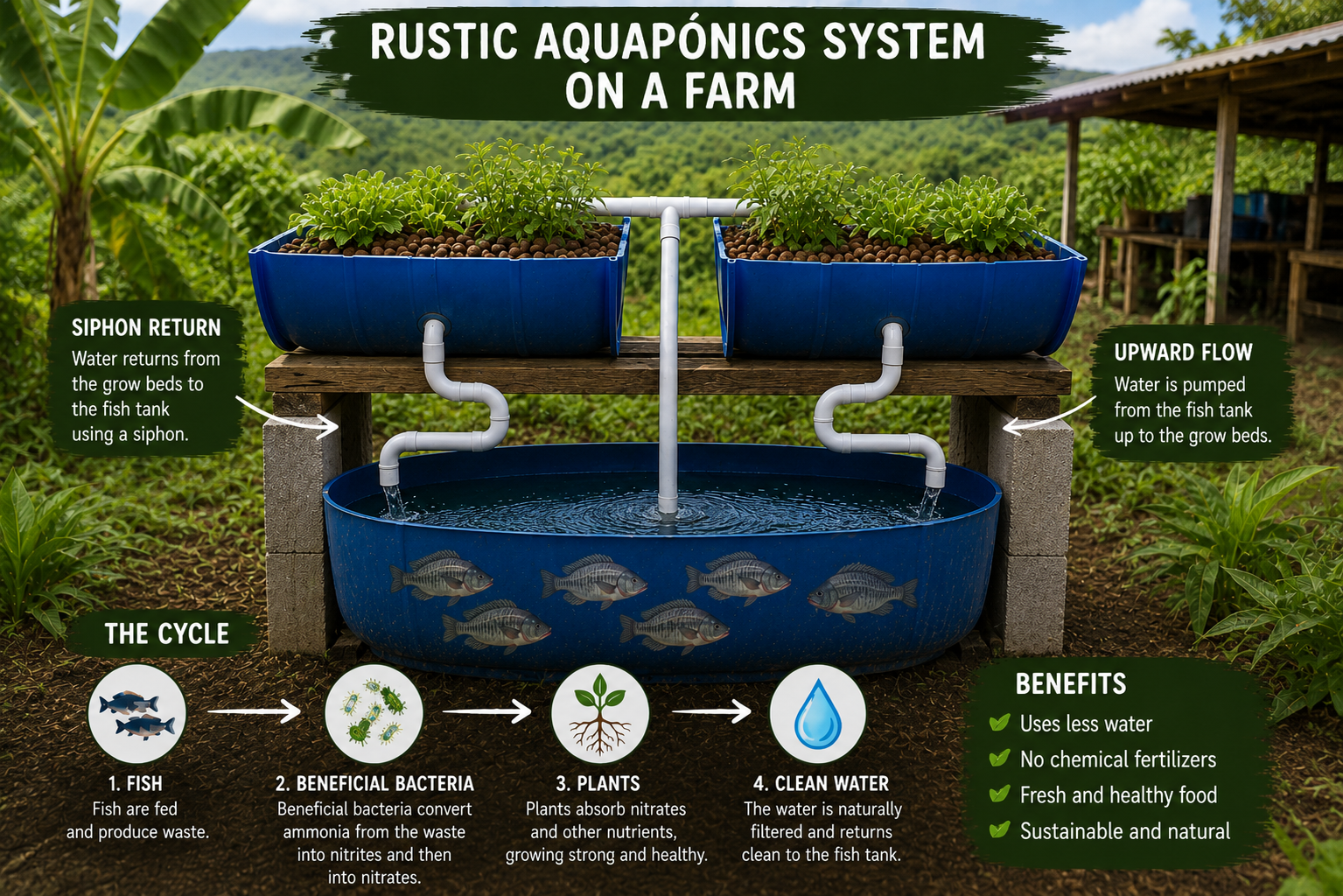
Then you can grow into a 50, 100, or 200 gallon tank with a grow bed. Later you can use IBC totes, cut barrels, gravel beds, floating beds, or modular systems.
- Micro system: small fish tank to learn.
- Homemade system: 50 to 200 gallon tank with one grow bed.
- Medium system: several beds, better filtration, and more plants.
- Production system: solids separation, dedicated biofilter, and greater control.
Basic components
- Fish tank: aquarium, barrel, plastic tote, or IBC.
- Water pump: moves water toward the plants.
- Grow bed: where plants grow and bacteria live.
- Growing media: washed gravel, lava rock, or expanded clay.
- Aerator: keeps oxygen available for fish and bacteria.
- Return: allows water to flow back to the tank by gravity.
- Filtration: removes solids and protects roots, pumps, and pipes.
A small system can be simple, but it should not be improvised. If oxygen is missing, if solids accumulate, or if flow stops, the system is compromised.
Correct system design
The design must balance tank volume, fish quantity, grow bed size, filtration, and water flow. It is not about having many plants or many fish. It is about the biology being able to process the load.
- Water must circulate constantly or in well-controlled cycles.
- The pump must move enough water without creating excessive turbulence.
- The bed must have enough depth for roots and bacteria.
- Solids should not accumulate in dead zones.
- The tank must receive constant oxygen.
A stable system is not the biggest one. It is the best balanced one.
Types of aquaponic systems
There are several ways to build a system. To start, the most practical option is usually a grow bed with solid media.
- Media bed: uses gravel or expanded clay. It works as support, mechanical filter, and biofilter. It is the most recommended option for learning.
- DWC: plants float over deep water. It is productive, but requires better filtration and oxygenation.
- NFT: uses a thin film of water in channels. It is efficient, but more sensitive to pump failures or blocked roots.
For a first homemade installation, media bed is the most forgiving option.
Cycling the system
Before seriously adding fish, the system must cycle. Cycling means that the bacterial colony capable of converting ammonia into nitrates becomes established.
- First stage: ammonia rises.
- Second stage: nitrites appear.
- Third stage: nitrates appear.
- Stable stage: ammonia and nitrites should be at zero.
Cycling can take 3 to 6 weeks. It can be accelerated with commercial bacteria, filter media from a mature system, or a controlled ammonia source.
Adding too many fish before cycling is one of the fastest ways to fail.
Parameters you must measure
Aquaponics is not managed “by eye.” You can observe the system, but the numbers matter.
- pH: ideally between 6.4 and 7.0 for balance between plants and bacteria.
- Ammonia: should be at 0 ppm in a stable system.
- Nitrites: should be at 0 ppm.
- Nitrates: should be present; they are food for plants.
- Dissolved oxygen: should remain high for fish and bacteria.
- Temperature: affects fish, bacteria, and plant growth.
If you do not measure, you are guessing. And in aquaponics, guessing gets expensive.
Recommended fish
Selection depends on climate, objective, and scale. Not all fish tolerate the same conditions.
- Tilapia: strong, fast-growing, tolerant, and good for production.
- Goldfish: hardy, ideal for learning, not for food.
- Koi: ornamental, hardy, good option if you are not looking to harvest fish.
- Bluegill: interesting option for outdoor systems.
To learn, start with few fish. The biological load should increase gradually.
Recommended plants
Not all plants require the same conditions. At the beginning it is best to plant leafy greens, because they consume nutrients more easily and respond quickly.
- Easy: lettuce, basil, kale, chard, spinach.
- Intermediate: cucumber, green onions, aromatic herbs.
- More demanding: tomato, pepper, eggplant.
Tomatoes and peppers can work very well, but they require a more mature system, higher nutrient load, and better stability.
Basic maintenance
- Check the pump and water flow.
- Observe fish behavior.
- Avoid overfeeding.
- Remove accumulated solids if the system requires it.
- Measure pH, ammonia, nitrites, and nitrates.
- Check roots to prevent blockages.
Maintenance does not have to be difficult, but it must be constant. Aquaponics rewards daily observation.
Common mistakes
- Adding fish before cycling.
- Using too many fish for too little filtration.
- Not providing enough oxygen.
- Not testing the water.
- Overfeeding.
- Designing poor returns or pipes that clog.
- Believing that because the water looks clear, it is healthy.
Conclusion
Aquaponics works because it converts waste into resources. It does not depend on magic, it depends on biology, moving water, oxygen, bacteria, and balance. You can start with a fish tank or build a large system, but the logic is always the same: feed fish, protect bacteria, and let the plants clean and take advantage of the system.
Success is not about spending more. It is about understanding the system before scaling it.