Living soil and natural fertility
How worms improve soil: a real explanation of the process
Worms don't "do magic." What they do is transform organic matter, move through the soil, activate microorganisms, and produce humus — one of the most stable and useful forms of natural fertility. In this guide you will understand, from scratch, what really happens underground.
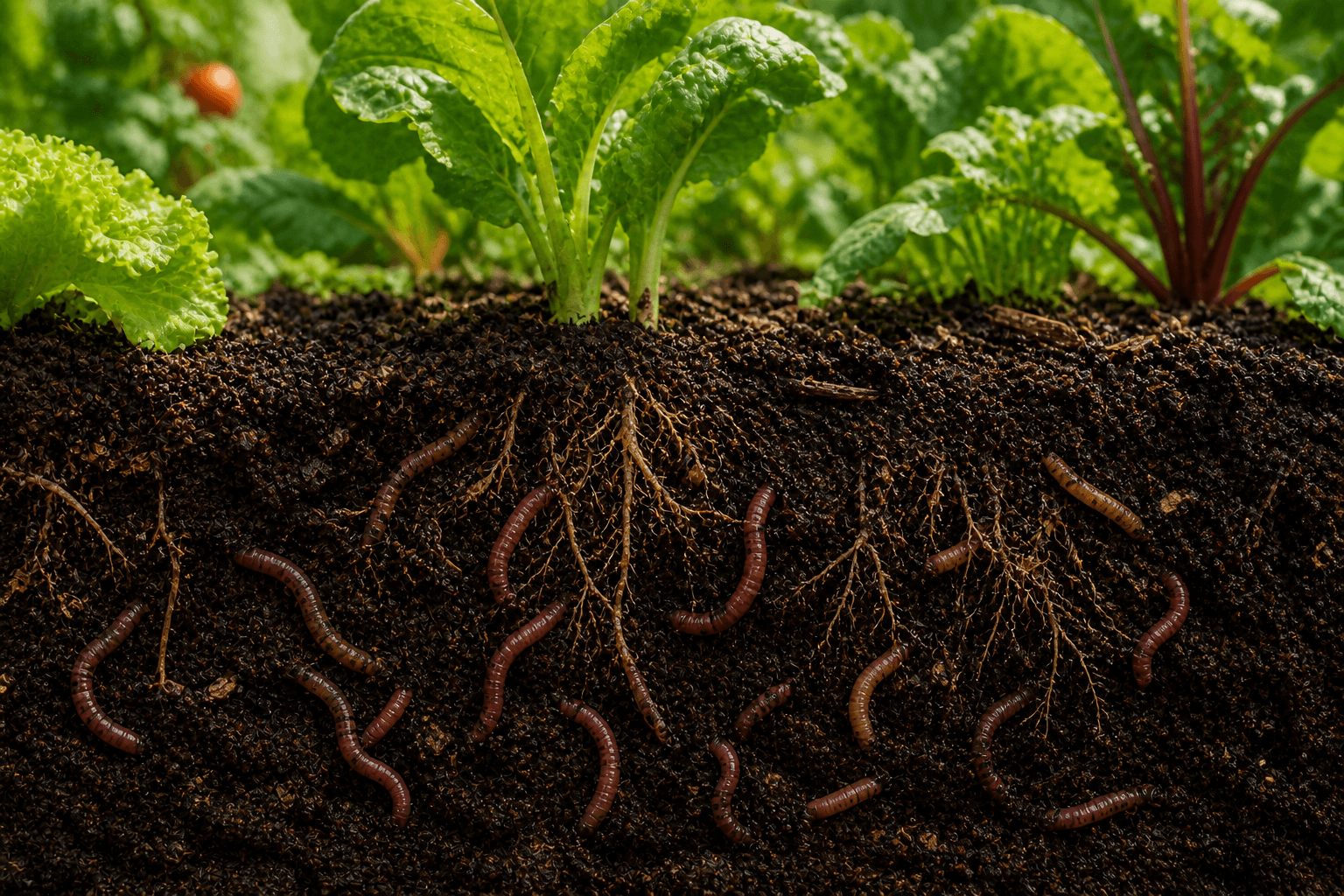
First: why are worms so important?
Healthy soil is not simply loose dirt. Healthy soil has air, moisture, organic matter, minerals, roots, fungi, bacteria, and small organisms all working together. Worms are part of that system.
Their main function is to process organic material and convert it into a more stable, finer form that integrates more easily into the soil. In that process they improve physical structure, nutrient availability, and biological activity.
Put simply: worms help turn organic waste into living soil.
The real process: what worms do step by step
1. They consume organic matter
Worms eat decomposing plant scraps, leaves, damp cardboard, microorganisms, fungi, and soil particles. They do not eat fresh food right away; microorganisms begin breaking it down first, and then the worm processes it.
2. They shred and mix the material
As material passes through their digestive system, it is fragmented, mixed with enzymes, and transformed. This increases the surface area available for beneficial bacteria and fungi to continue their work.
3. They produce worm humus
The end result is fine, dark, and stable castings known as worm humus or vermicompost. This humus is rich in stabilized organic matter and helps improve soil fertility.
4. They create tunnels and pores
As they move, worms open channels in the soil. Those channels allow oxygen to enter, water to penetrate more easily, and roots to find clearer paths to grow.
5. They activate microbial life
Worms do not work alone. Their presence encourages bacteria, fungi, and other microorganisms that participate in nutrient release and the overall health of the soil.
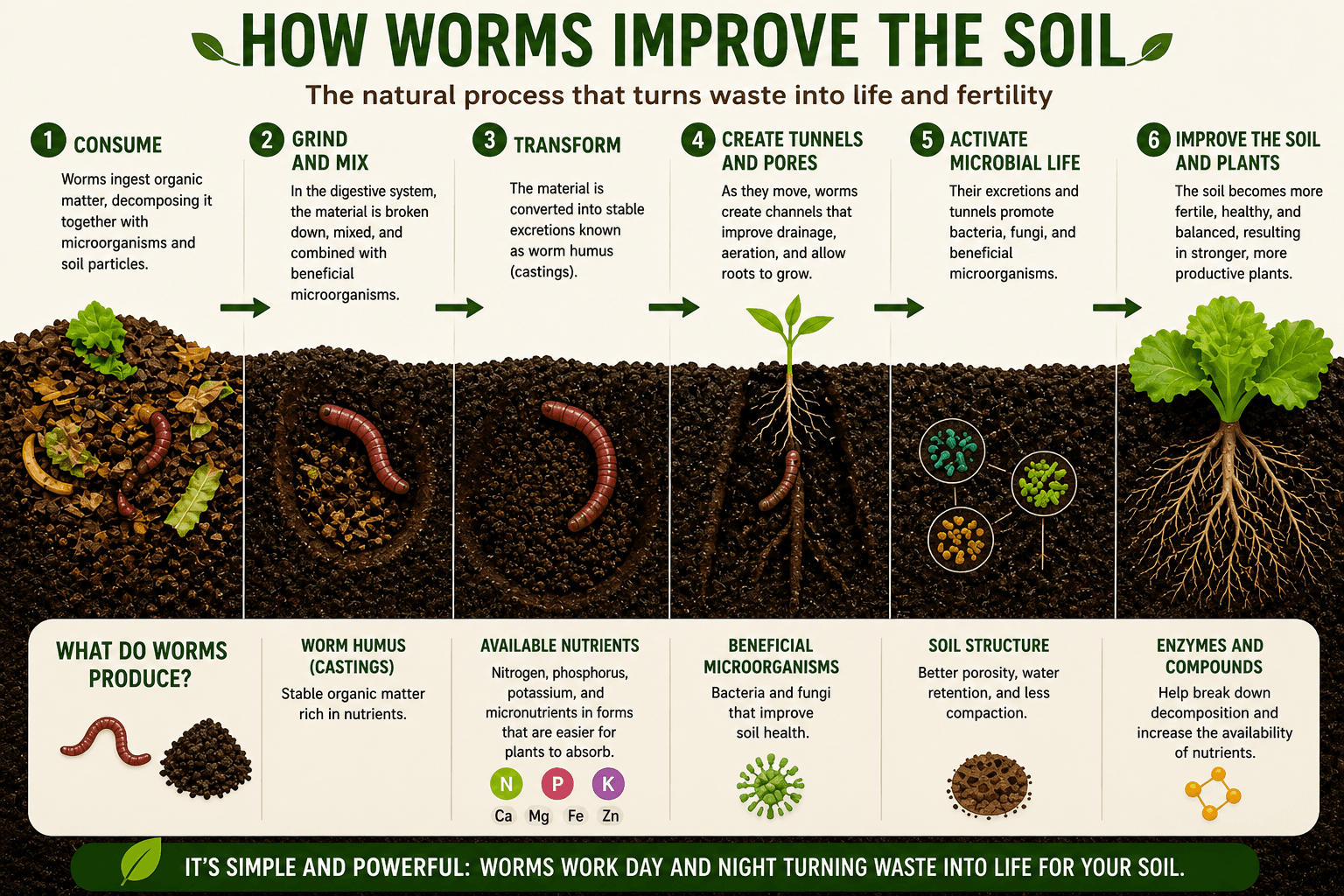
What components they contribute to the soil
Worm-produced humus does not always have an identical composition. It depends on diet, moisture, temperature, bedding type, and process maturity. But in general, it can contribute these components:
Stable organic matter
Improves soil texture, increases moisture retention, and helps keep nutrients available for longer.
Primary nutrients
May contain nitrogen, phosphorus, and potassium in forms more accessible to plants, though it should not be seen as a strong fertilizer like chemical products.
Micronutrients
Can provide iron, zinc, manganese, copper, boron, calcium, magnesium, and other elements needed in small amounts.
Beneficial microorganisms
Well-made humus can introduce useful bacteria and fungi that help activate soil life.
Humic and fulvic acids
Help improve nutrient availability and the interaction between soil, roots, and microorganisms.
Enzymes and bioactive compounds
Participate in biological processes that help break down organic matter and gradually release nutrients.
The most important point
Worms improve soil in three main ways: physically, by aerating and loosening it; chemically, by helping release nutrients; and biologically, by encouraging useful microorganisms. That combination is what creates truly fertile soil.
What having worms in the system is good for
Having worms in a vermicomposter or healthy soil transforms organic waste into an agricultural resource. Instead of throwing away peels, leaves, and plant scraps, you can turn them into humus that benefits your plants.
In home gardens, this is valuable because it reduces waste, improves the soil, and lets you rely less on purchased products.
Practical benefits
Improves soil structure.
Increases moisture retention.
Helps roots grow better.
Activates beneficial microorganisms.
Recycles organic waste.
Produces humus useful for pots and garden beds.
Reduces compaction.
Improves nutrient availability.
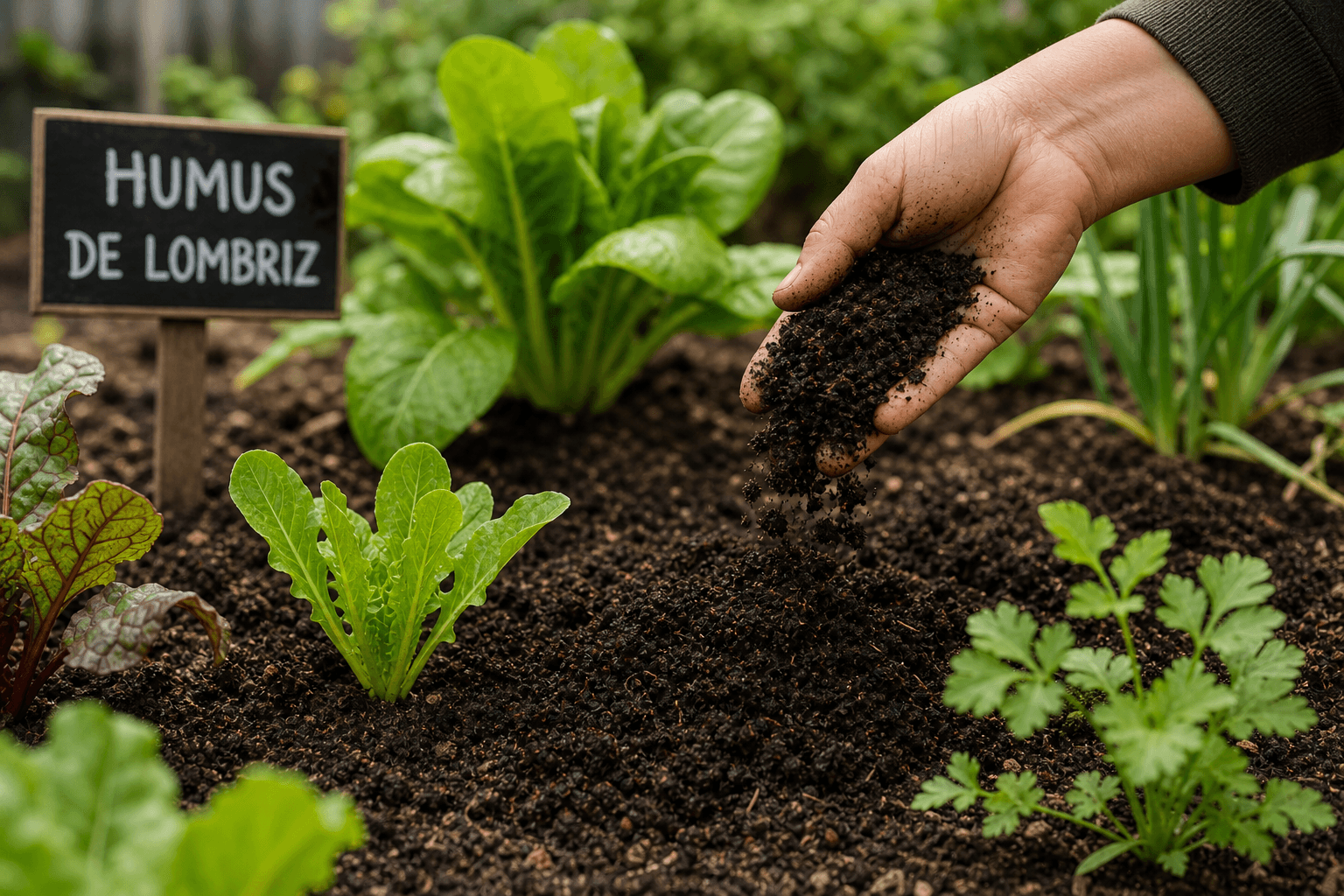
How to use worm humus correctly
Worm humus is used as a soil amendment. You do not need to apply excessive amounts. The ideal approach is to mix it with soil or apply it as a top layer around plants.
In pots
Mix between 10% and 20% worm humus with the growing medium. For example, when preparing a pot you can use 8 parts soil or potting mix and 2 parts humus.
In garden beds
Apply a 1 to 2 inch layer over the growing bed and gently mix it into the top of the soil. There is no need to bury it deep.
Around established plants
Add a handful or thin layer around the plant, keeping it away from direct contact with the stem. Then water so the microbial life activates.
In seedling trays
Use sparingly. Humus helps, but seedlings need a fine, lightweight medium with good drainage. Too much heavy material can retain excessive moisture.
How to keep worms healthy
For worms to work well, they need moisture, oxygen, shade, adequate food, and moderate temperature. If the system overheats, dries out, or rots, the worms become stressed or die.
Correct moisture
The bedding should feel like a wrung-out sponge: damp, but not dripping.
Good ventilation
They need oxygen. If the system compacts or becomes waterlogged, it turns anaerobic and smells bad.
Balanced diet
Use vegetable scraps, leaves, damp cardboard, and small amounts of coffee grounds. Do not overfeed.
Moderate temperature
Avoid strong direct sunlight. Excessive heat can kill worms very quickly.
Common mistakes
Thinking any worm works the same way
Vermicomposting uses composting worms, especially the red wiggler. Not all worms work the same way or live well in containers.
Adding too much food
If you add more food than the worms can process, the material rots, flies appear, and the system starts to smell bad.
Keeping the bedding too wet
Worms breathe through their skin. If everything is waterlogged and oxygen-free, the system becomes dangerous for them.
Using humus before it is ready
Finished humus should look dark and fine, smell like damp earth, and have no large pieces of fresh food. If there is still rotting material, it is not ready.
Important warning
If a worm bin smells like rot, ammonia, strong vinegar, or sewage, something is wrong. It is usually too much food, too much moisture, or lack of air. A healthy worm bin should smell like damp earth, not garbage.
Quick summary
What they do: transform organic matter into humus.
How they help: aerate, mix, and activate the soil.
What they produce: humus rich in organic matter.
What they contribute: nutrients, microorganisms, and structure.
Ideal use: pots, garden beds, and established plants.
Key care: moisture without excess water.
Do not: overfeed the worm bin.
Good sign: smells like damp earth.
Conclusion
Worms improve soil because they accelerate the transformation of organic waste into fertile, stable matter. By eating, moving, and producing humus, they change soil structure, increase microbial life, and help plants have a healthier environment to grow in.
If you are starting out with home gardening, understanding this process gives you a huge advantage. It is not just about having worms; it is about creating a balanced system where food, moisture, oxygen, and microorganisms work together. That is where soil truly begins to improve.